
The most trustworthy Frost object in the Derry farmhouse may be the least theatrical: a soapstone kitchen sink. It belonged to the house and still carries knife marks made by the Frosts and later occupants. Nearby, the family’s Royal Doulton china is genuine. The Morris chair is a replica, the wallpaper was selected during a 1970s restoration, and much of the furniture is period-appropriate rather than original.
Frost Farm Is Not an Untouched Poetry Landscape
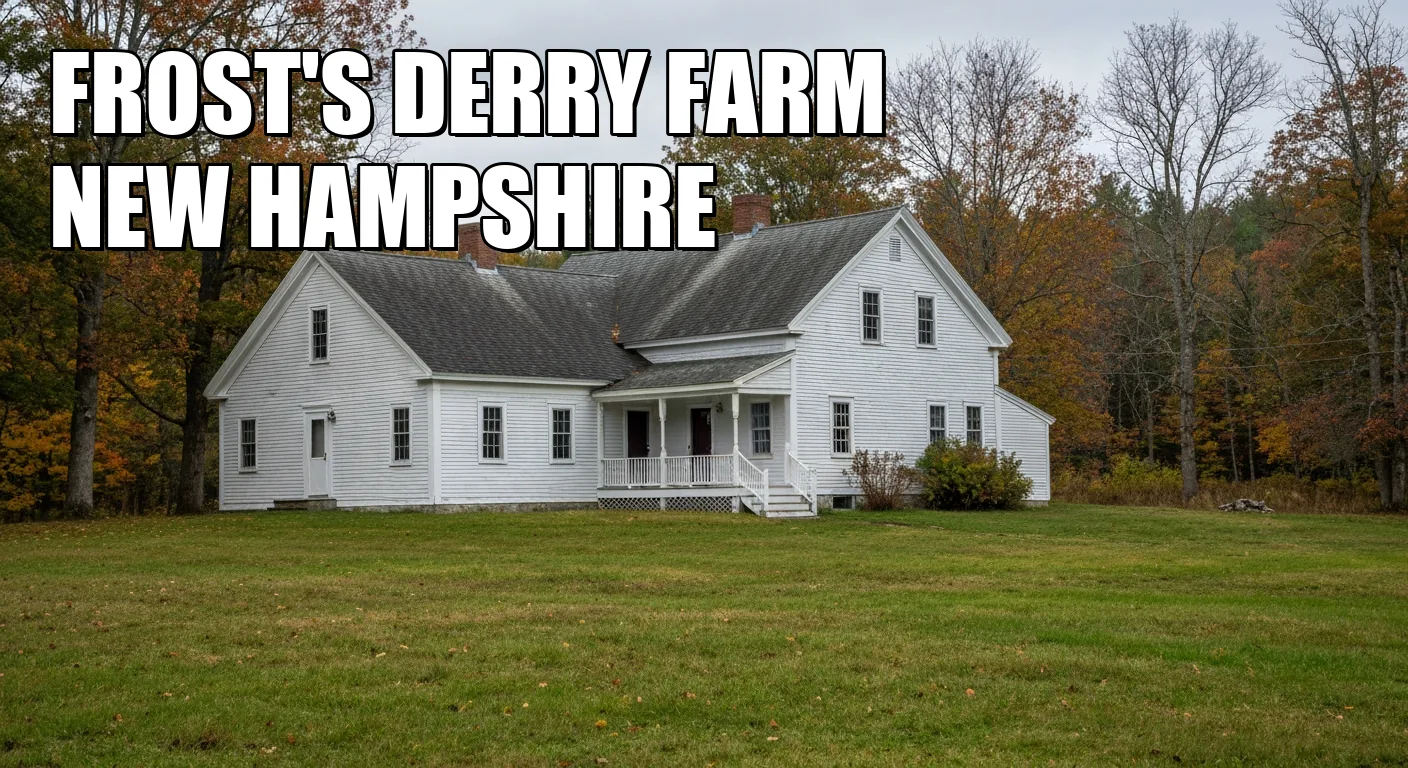
Four layers of evidence at the farm
| What you see | What the record supports | What it does not prove |
|---|---|---|
| House, rear wing, woodshed and barn | The connected building group predates Frost and remained relatively unchanged in exterior character through later use | That every visible surface or room detail is from 1900–1909 |
| Furnished rooms | A restoration based on photographs, records and the participation of Frost’s daughter Lesley | That most furniture occupied that exact room when the family lived there |
| Fields, orchard setting and trail | A modern historic site built around surviving land and a reclaimed pastoral setting | An untouched version of the farm Frost worked |
| Poem signs and “Mending Wall” point | Interpretation grounded in Frost’s Derry years and, in some cases, named local people or features | That every marker stands where its poem was written or that the present stones have a documented chain of custody |
The building survived a use that erased much of the farm
Frost moved to the property, then known as the Magoon Place, in fall 1900. The main house, one-story rear wing, woodshed and gable-roofed barn were already there. During the family’s residence, the first floor held a parlor, dining room and small bedroom in the main section, with the kitchen, pantry and laundry in the wing. The woodshed connected domestic rooms to the barn.
The Frosts left the farmhouse in 1909, although Frost retained ownership until 1911. Later, the property became a used-car-parts business. Its owner removed the orchard, sold topsoil, leveled ground near the buildings and put a concrete-block garage behind the barn. Wrecks, metal and glass spread across former fields and pastures. When New Hampshire acquired the homestead in 1965, the land had been substantially altered, but the deteriorated house, shed and barn were still described as relatively unchanged.
The rooms are a documented restoration, not a frozen household
Restoration began in earnest in 1974. Workers removed a modern bathroom from beneath the front stairs, rebuilt the pantry, repaired the foundation and structure, replaced the roof and renewed damaged interior fabric. Early photographs and architectural records guided the work, while Lesley Frost Ballantine helped shape the interpretation of her family’s life.
The restoration changes the question from “Did Frost touch this?” to “What evidence was used to reconstruct this household?”
The poetry trail crosses a recovered landscape
The self-guided trail runs roughly half a mile around the property and uses fourteen poem signs to direct attention to the landscape. In Frost’s years, the farm included an orchard, garden, hayfields, pastures, hardwoods and a west-running brook. Those features gave him material, but the present route did not pass untouched through the intervening decades.
The auto-salvage period removed the orchard and changed the ground itself. The state cleared the junk, demolished the later garage, acquired adjacent parcels and set out to recover the site’s scenic character. The official record does not establish that the original farm contours were completely restored. The trail therefore works best as an interpretive sequence across a reclaimed place, not as a preserved path Frost is known to have walked.
“Mending Wall” has a named neighbor, not a proven set of stones
The strongest poem-to-place connection involves Napoleon Guay, the owner of an abutting property. Accounts identify Guay with the annual repair of their boundary wall and with the proverb “good fences make good neighbors.” This gives the poem a specific Derry relationship rather than a generic New England backdrop.
The surviving sources stop short of authenticating the wall shown to visitors stone by stone. Official trail material points out “the mending wall,” but no documented construction history or physical survey establishes that the present stones are the undisturbed boundary Frost and Guay repaired. The neighbor and ritual are documented; the exact material survival is not.
Derry produced poems, but not a literal origin marker for each one
Frost later wrote that during his Derry years he completed more than half of his first book, much more than half of his second and some of his third. That statement supports Derry as a decisive writing period. It does not assign every poem to the farmhouse, because his Derry residence continued after the family moved from the farm into the village.
Individual works carry different levels of proof. An early version of “The Death of the Hired Man” was finished around 1905, placing composition within the farm years, but the selected record does not identify its hired man or action with this property. “The Tuft of Flowers” was published locally while Frost lived at the farm and helped establish his standing in Derry. Apple trees, mowing, birches, the brook and rural speech all belonged to the world he observed, yet resemblance between a feature and a poem is not the same as a documented drafting location.
The poultry yard, now gone, explains the Derry breakthrough
Frost arrived with nearly 300 Wyandotte chickens and built two large poultry houses east of the barn. Neither poultry house survives. He kept egg records and between 1903 and 1905 sold eleven pieces to poultry trade journals—prose his editor treated as entertaining fiction as much as instruction. By 1906, Frost’s attention had shifted toward teaching at Pinkerton Academy, although he continued some farming.
Derry gave Frost sustained contact with work, neighbors and local speech, but it also exposed the limits of farming as his occupation. The poetry grew alongside poultry articles, teaching and a deliberate search for readers.
Part of ⭐ Famous Residents
Famous Residents
Mount Vernon Tickets, Mansion Tour, and What to See at George Washington’s Estate
A first-timer’s Mount Vernon guide covering timed mansion entry, how long to budget, what is included beyond the house, and how the estate now frames slavery as central history.

Famous Residents
Humphrey Bogart Homes: The Los Angeles Addresses Fans Still Search For
Most Bogart addresses in Los Angeles are private residential properties. Here is which stops are publicly accessible, what each address documents, and how to frame the trip.
Famous Residents
Walden Pond and Thoreau's Cabin: Replica, Site, and What Is Original
The cabin near the lot is a replica; the documented site is a half-mile away. A field guide to scale, archaeological location, landscape change, and access.

From the author of this guide
Check In After Dark
One writer checks into the rooms with the stories — Stanley 217, Banff Springs 873, the Del's 3327 — and reports what the night is actually like.