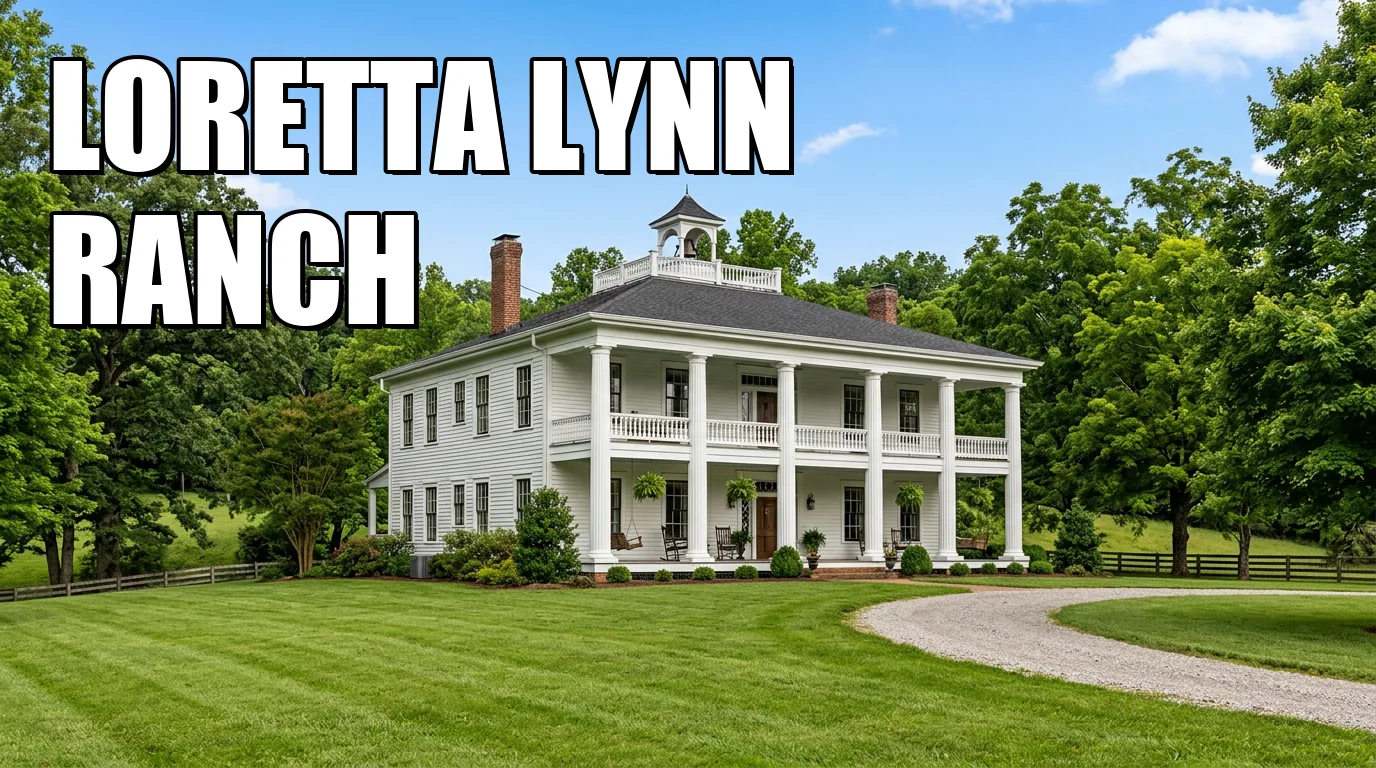
The large white house toured at Loretta Lynn’s Tennessee ranch is an authentic adult home, but it is not the antebellum plantation mansion the nickname suggests. National Register documentation identifies it as the Hillman-Anderson Farmhouse, an I-house built in stages from about 1876 to 1916. Loretta and Oliver “Mooney” Lynn moved into it in spring 1967 and moved out in 1988.
The Butcher Holler cabin at the ranch reverses that formula. Loretta did not grow up in the Tennessee structure. The National Register nomination says she had the replica constructed at Hurricane Mills in 1988 by reassembling the Coal Miner’s Daughter movie set.
Four Loretta Lynn sites, four kinds of authenticity
| Site | What is authentic | What it should not be called |
|---|
| Hillman-Anderson Farmhouse, Hurricane Mills | A historic post-Civil War house occupied by Loretta and Mooney and used in the 1980 film | An antebellum or documented plantation house |
| Butcher Holler cabin, Tennessee ranch | A replica reassembled from the Coal Miner’s Daughter movie set | Loretta’s original childhood home |
| Coal Miner’s Daughter Museum | Career artifacts, clothing, awards, and objects connected to Loretta and the film | A preserved residence from her life |
| Webb family home, Butcher Hollow, Kentucky | The surviving childhood house associated with Loretta Lynn and Crystal Gayle | Part of the Hurricane Mills ranch tour |
The “Plantation Home” is a postwar I-house
Ranch tourism material calls the toured residence the Plantation Home. The federal historic record uses a different description. In the Hurricane Mills Rural Historic District, the Hillman-Anderson Farmhouse is a contributing I-house with porches and extensions built in stages from approximately 1876 through 1916.
That chronology begins more than a decade after the Civil War. “Antebellum” and “pre-Civil War” are therefore inaccurate descriptions of the structure’s age. “Plantation Home” can identify the attraction as the ranch names it, but it should not be upgraded into a documented account of the house’s original function.
The correction does not make the home less relevant to Loretta. The Lynns bought the farm in April 1966, moved into the farmhouse in spring 1967, and remained there until 1988. The public guided home tour enters a real Lynn residence from her years of fame.
The mansion was not her final ranch residence
After 1988, Loretta moved to a smaller private residence behind the mansion. That later home is biographically authentic but is not identified as part of the current public home tour in the official visitor material reviewed here.
This distinction matters when a tour is described as “Loretta Lynn’s home.” The Hillman-Anderson Farmhouse is genuinely a home she occupied for roughly two decades. It is not the only house she used at Hurricane Mills, and touring it does not mean entering every period of her life on the ranch.
The Tennessee cabin is both replica and film artifact
The ranch’s Butcher Holler cabin reproduces the Webb family home in Kentucky. Loretta did not grow up in the Tennessee structure. It belongs to the ranch’s interpretation of her childhood rather than to the original geography of that childhood.
Its film provenance is nevertheless real. The National Register nomination says that in 1988 Loretta had a replica of her eastern Kentucky childhood home constructed at Hurricane Mills and that it was reassembled from the Coal Miner’s Daughter movie set. The sequence matters: the current ranch cabin is a post-film installation made from set material, not the original Webb house transplanted from Kentucky.
The ranch also contains original movie locations. The same federal record says the farmhouse interior and exterior, surrounding farm, bridge, and church were used as sets. A visitor can therefore encounter both a real Lynn home that appeared on screen and a replica assembled from a film set.
The museum’s authenticity belongs to its objects
The Coal Miner’s Daughter Museum is a career museum, not a preserved house. Its value lies in the collection: stage clothing, awards, personal material, and items associated with the film and Loretta’s career.
A museum object can be original even when the gallery building is not a historic residence. Visitors looking for performance history, costumes, and the public career should prioritize the museum; visitors looking for domestic space should prioritize the guided Hillman-Anderson Farmhouse tour.
The original childhood home is in Kentucky
The Webb family home stands in Butcher Hollow outside Van Lear, Kentucky. Official local visitor material describes it as the cabin where Loretta Lynn and Crystal Gayle grew up, with tours guided by local historians or Webb family members.
The stated access instructions begin at Webb’s General Store No. 5. Sources conflict on whether the cabin is a short walk from the store or approximately two miles farther up the hollow, so visitors should use the family’s current directions rather than assume the Tennessee ranch ticket or route includes it.
The two states answer different questions. Hurricane Mills preserves Loretta’s adult success through a real residence, a career collection, and reconstructed interpretation. Butcher Hollow preserves the childhood place itself.
Loretta Lynn’s story is not contained in one “authentic ranch.” Hurricane Mills combines an adult home with a misleading historical label, genuine movie locations, a replica made from film-set material, and a museum of original career objects. The surviving childhood house remains in another state.
The Cornerstone Brief
One historic place, once a week — what it is, why it matters, whether it's worth going. No filler, no paid placements.
Coming soon. Unsubscribe any time.