Famous Residents

Stepping Inside Mackintosh's Mind: A Guide to The House

Find Nearby Hotels

Book Flights

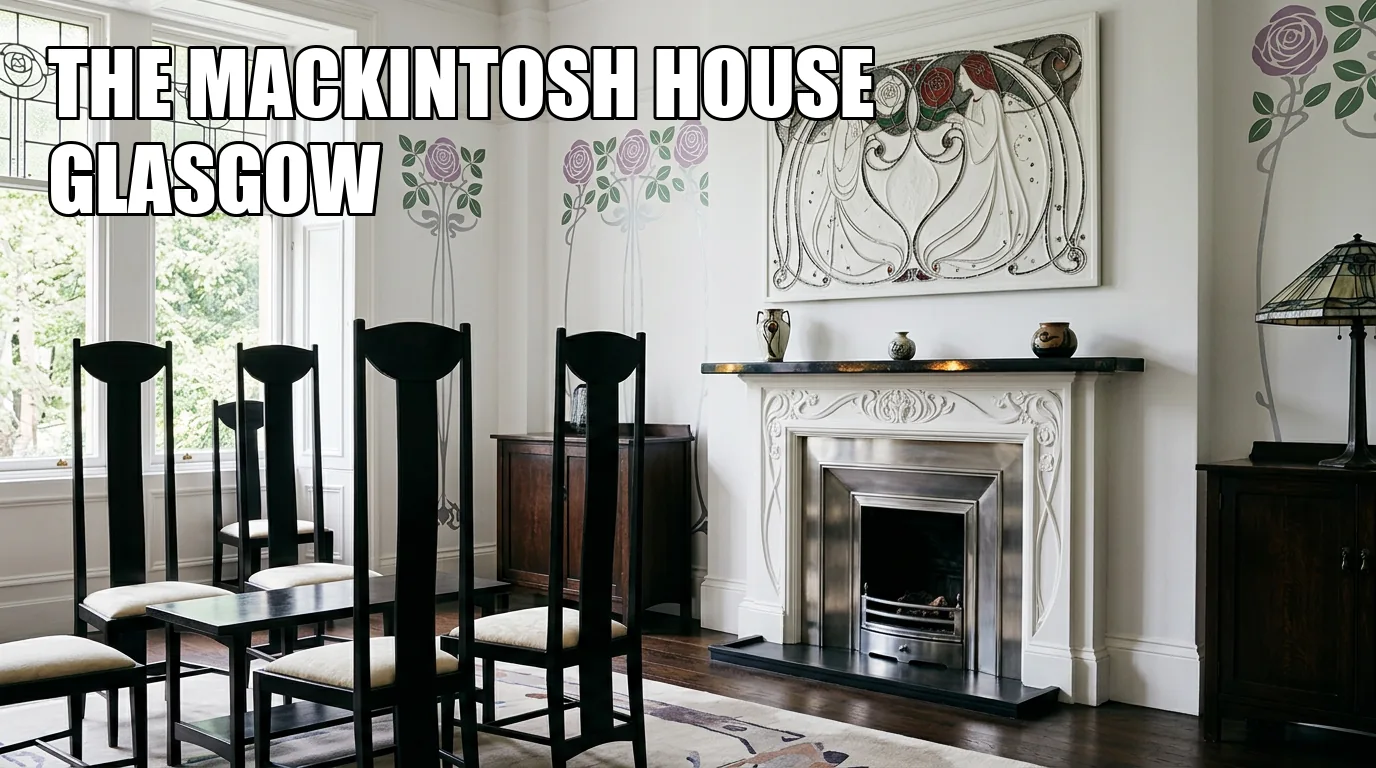
Most travel guides present historic homes as static snapshots, carefully curated and often devoid of the very life that once animated them. But for anyone venturing to Glasgow to experience Charles Rennie Mackintosh’s architectural genius firsthand, the Mackintosh House at the University of Glasgow’s Hunterian Art Gallery offers something far more compelling: a painstakingly reanimated spirit, not just a structure. This isn't just a house; it’s a living testament to Mackintosh's holistic design philosophy, meticulously reconstructed to envelop visitors in his unique vision. What makes this particular reconstruction so different from others you might encounter, say, Colonial Williamsburg or even some grand European palaces? It’s the profound commitment to authenticity, especially in its furnishings. When the original 78 Southpark Avenue—then known as 6 Florentine Terrace—faced demolition in the early 1960s, a team undertook an extensive architectural survey, carefully removing every salvageable fixture. The resulting reconstruction, completed in 1981 by Whitfield Partners, doesn't merely replicate the shell; it reconstructs the *experience*, positioning itself as an integral part of the Hunterian Art Gallery to precisely reflect the sequence and spatial qualities of the Mackintoshes' home from 1906 to 1914.

The Soul of a Home, Rebuilt: Why This Reconstruction Matters

Few historic houses, even original ones, boast the sheer volume of personal artifacts the Mackintosh House does. Here’s the critical detail often overlooked: virtually every piece of furniture within these walls belonged to Charles Rennie Mackintosh and his wife, Margaret Macdonald Mackintosh. This isn't a collection of period-appropriate replicas or sympathetic acquisitions; these are the actual chairs, tables, and cabinets designed by Mackintosh for his own daily life. This distinction is paramount, illustrating how each item was conceived not as a standalone object, but as an essential, integrated component of his broader architectural and interior design philosophy, forming a unified environment where every line and curve contributed to the whole. The story behind securing these pieces is almost as compelling as the designs themselves. Many items were gifted alongside the house purchase by the Davidson family, ensuring their provenance. What this means for the visitor is an unparalleled opportunity to see Mackintosh's grand vision in miniature, observing how his larger architectural principles translated into the intimate scale of domestic objects. It’s a remarkable achievement, allowing us to step into the very rooms where such groundbreaking art and design were conceived, rather than simply viewing them from behind a velvet rope.

Decoding Mackintosh's Seating: A Tale of Two Chairs

If you’re keen on Mackintosh, you know his high-backed chairs are iconic. But the Mackintosh House presents a fascinating comparative study, revealing the evolution and contextual adaptation of these famous designs. In the opulent drawing room, for instance, you’ll encounter the distinctive stencilled chairs and an oval table that once formed part of "The Rose Boudoir," a celebrated room setting first exhibited at the 1902 First International Exhibition of Modern Decorative Art in Turin. These chairs, decorated in silver, white, and rose tones, are early exemplars of a typology that would make him internationally renowned, embodying the delicate, almost ethereal quality often associated with his initial success. Contrast those with the earlier high-back chairs found in the dining room, which actually predated the house itself. These were originally designed in 1898 for Miss Cranston's Argyle Street Tea Rooms in Glasgow, made by Francis Smith and Son—a principal local cabinet-making firm Mackintosh regularly engaged. These pioneering designs, costing a mere £1.8.6d each at the time, featured an oval headrest with a bird-in-flight silhouette, serving both an aesthetic purpose and a deeply functional one: the soaring backs provided a measure of privacy for diners in a public space, while simultaneously acting as architectural elements, shaping the room’s perceived dimensions and flow. Seeing these two distinct applications side-by-side truly underscores Mackintosh’s genius for adapting and re-contextualizing his designs across different scales and functions.

The Studio's Secrets: A Desk, a Collaboration, and Missing Records

Moving into the studio, a particular piece commands attention: the mahogany writing cabinet. This ebonised piece—meaning it's stained or painted to look like ebony—is incredibly rare, representing one of only two examples ever produced. It’s a masterful fusion of rectilinear and curvilinear forms, incorporating sophisticated decorative materials. The cabinet was so significant that it fetched a world-record price in 1979 following an international appeal to secure it for the collection, embodying Mackintosh's mature design aesthetic from its original conception in 1904. Yet, remarkably, the specific maker of this iconic cabinet remains largely undocumented, a stark reminder of the frustrating gaps in contemporary record-keeping for such domestic commissions. It's a mystery that adds another layer of intrigue to the piece, prompting contemplation on the often-anonymous hands behind great design. Not far from this enigmatic cabinet, one might consider another striking example of Mackintosh's writing furniture: the "Kimono Desk," designed in 1904 for Hill House in Helensburgh. Crafted by Alex Martin, another crucial Mackintosh collaborator active from 1898 to 1909, this desk was made from ebonised mahogany, exquisitely inlaid with mother-of-pearl, ivory, and glass. It likely featured a leaded glass and enamelled steel panel, believed to be the work of Margaret Macdonald, incorporating delicate rose petal motifs. Mackintosh admired this design so much he commissioned a replica for his own use, suggesting a deep satisfaction with this particular collaborative outcome—a testament to the power of artistic synergy.

The Unsung Hands: Artisans, Margaret, and the Craft of Genius

It’s easy to credit Charles Rennie Mackintosh alone for the brilliance of his designs, but to do so would be to miss a crucial part of the story. The Mackintosh House vividly illustrates the indispensable role of skilled artisans and, perhaps most importantly, the profound contributions of Margaret Macdonald Mackintosh. Craftsmen like Alex Martin and Francis Smith were not mere executors; they were pivotal partners, translating Mackintosh's drawings into tangible form and occasionally offering technical innovations to overcome construction challenges. Mackintosh, ever the exacting visionary, maintained absolute control over the formal conception, but the precision and artistry of the final product rested firmly in the hands of these dedicated makers. Beyond collaborative design, Margaret Macdonald Mackintosh's contributions extended into autonomous artistic production, a fact often minimized in broader narratives. In the drawing room, for example, the white desk incorporates decorative silvered metal panels that are unmistakably her creation, a direct artistic statement within the interior. Across Mackintosh’s projects, Margaret was responsible for stunning gesso panels—a plaster-based medium—and intricate enamelled glass components. Her achievements in gesso were, in fact, unmatched in Britain at the time, showcasing a sophistication that truly set her apart. While the precise division of labor on every single piece remains incompletely documented, contemporary accounts firmly place Macdonald as an integral force in developing the richly decorative and symbolic interiors that defined their shared aesthetic throughout the early 1900s. Her genius, rather than simply complementing his, often elevated it. This period, around the 1906 commission for Southpark Avenue, was a fascinating juncture for the couple; Mackintosh's international reputation was ascending, even as design opportunities in his native Glasgow began to contract, leading them to strategically repurpose many earlier designs for their new home, rather than always commissioning entirely new ensembles.

Navigating the Experience: Practicalities and Deeper Insights for 2025-2026

Approaching the Mackintosh House for your visit is a different experience than a typical museum. For conservation reasons and to foster an intimate encounter, admission is self-guided, with a strict maximum of 12 visitors permitted simultaneously. This limitation, rather than a hindrance, becomes a blessing, allowing for quiet contemplation of the interiors without the usual bustle. The house is open Tuesday to Sunday from 10 am to 5 pm, with last admission at 4:15 pm (it closes on Mondays). Do note there is an admission charge of £10, with concessions at £6, which distinguishes it from the broader Hunterian Museum and Gallery collections that are often free to enter. What often surprises first-time visitors is the deliberate absence of extensive didactic interpretation *within* the house itself. You won't find placards on every wall explaining each item in detail. This curatorial choice, limiting in-depth guidance to a separate Introduction Gallery, is a conscious effort to create an experiential approach, allowing you to encounter the spaces as inhabited environments rather than annotated museum displays. It preserves the phenomenological qualities of the historical interiors, encouraging you to absorb the atmosphere and spatial effects directly. For those seeking deeper contextual understanding, student-led guided tours of the Hunterian Art Gallery are available at scheduled times (Tuesdays: 1 pm, 2 pm; Wednesdays: 1 pm, 2 pm, 3 pm; Thursdays: 1 pm, 2 pm; Fridays: 2 pm; Saturdays & Sundays: 12 pm, 2 pm). Plan for a typical visit duration of 1-2 hours, providing ample time to move through the hall, dining room, studio-drawing room, and main bedroom. A crucial practical tip: for conservation and security, bags of any kind cannot be brought into the house, so make use of the secure locker storage available in the basement level before you enter. For those planning a visit in 2025 or 2026, pre-booking tickets through the Hunterian Art Gallery's official website (gla.ac.uk/hunterian) is highly recommended to avoid queuing, especially during peak visitor periods like school holidays or weekends. The gallery maintains its standard schedule, but always double-check the website for any temporary closures related to special exhibitions or conservation work—it’s always best to be prepared. As of late 2025, Glasgow is celebrating its 850th anniversary with the "Glasgow 850" program, extending through December 2025, with related exhibitions like "Building Memories" continuing into January 2026. This might mean increased foot traffic, so timing your visit strategically, perhaps on a weekday morning, could enhance your quiet immersion. Ultimately, the Mackintosh House offers an unparalleled opportunity to truly step inside the mind of one of Scotland's most visionary designers, making it an essential pilgrimage for anyone keen on understanding the origins of modern design.

Exploring Charles Rennie Mackintosh: Design Masterpieces Around the World

What is the Charles Rennie Mackintosh tour?
The Charles Rennie Mackintosh walking tour in Glasgow is a 2-hour guided experience (£18 per person) that explores the life, works, and architectural legacy of the renowned Scottish designer and architect, concluding with access to Mackintosh at the Willow exhibition and tea room.
How much does it cost to go to the Mackintosh House in Glasgow?
Admission to the Mackintosh House at the Hunterian Art Gallery is £10 for adults and £6 for concessions (seniors, students, unemployed); children under 18 and various membership holders enter free.
How much does it cost to visit 78 Derngate?
Entry to 78 Derngate (The Charles Rennie Mackintosh House) in Northampton is £12.00 for adults, with free admission to the visitor centre galleries, shop, and dining room.
How long does it take to tour 78 Derngate?
A guided tour of 78 Derngate takes approximately 30 minutes, allowing visitors to experience the four-floor Georgian terraced house with its remarkable Mackintosh interior transformation.
What makes 78 Derngate special?
78 Derngate is the only Mackintosh-designed house outside Scotland and his last architectural project, featuring extraordinary modernist interiors with clean lines, geometric precision, and iconic design elements including the distinctive Hall Lounge with rose motifs and meticulously crafted furnishings.
Is it worth visiting Mackintosh at the Willow?
Yes, Mackintosh at the Willow is highly recommended by visitors as the only surviving tea room designed by Charles Rennie Mackintosh, offering an authentic 1903 experience with beautiful Art Nouveau interiors, excellent afternoon tea, and informative tours about Glasgow's design heritage.
Charles Rennie Mackintosh house experience
The Mackintosh House in Glasgow provides an intimate glimpse into the life of Charles Rennie Mackintosh and his wife Margaret Macdonald through carefully reconstructed interiors featuring original furnishings and decoration, including the striking white drawing room with beaten silver panels.
How much does it cost to visit the Winchester Mystery House?
Winchester Mystery House mansion tours cost $38.99 for adults, $32.99 for seniors, and $17.99 for children ages 5-12, with specialized flashlight tours available at $49.99 for adults and $29.99 for children.
How much is entry to the Van Gogh Museum?
Entry to the Van Gogh Museum in Amsterdam is €26 for standard timed-entry tickets, with student rates at €11 and various combo passes available starting at €37.50.
How much does it cost to visit the Kiyomizu Dera Temple?
Admission to Kiyomizu-dera Temple in Kyoto is 500 yen for adults and 200 yen for junior high and elementary school students, with no advance reservation required.
What is displayed at the Mackintosh House Glasgow?
The Mackintosh House features a careful reassemblage of the main rooms from Charles Rennie Mackintosh and Margaret Macdonald Mackintosh's former Glasgow home, showcasing their distinctive design with austere furnishings and iconic architectural elements.
What are the opening hours for Mackintosh House Glasgow?
The Mackintosh House is open Tuesday to Sunday, 10:00am-5:00pm, with last admission at 4:15pm; it is closed Mondays. Tours run approximately every 30 minutes.
Can I visit Charles Rennie Mackintosh houses in the United States?
There are no houses designed by Charles Rennie Mackintosh in the United States; his major works are located in Scotland (Glasgow, Helensburgh) and England (Northampton's 78 Derngate), though some of his designs and influence can be seen in American museum exhibitions.
What areas of Mackintosh at the Willow can I visit?
Mackintosh at the Willow features three main design spaces: the Front Saloon (inspired by meadows with light, airy décor), the Back Saloon (cosy, forest-floor inspired interior), and the Gallery, all showcasing the original 1903 tea room design.
Is booking in advance recommended for Mackintosh attractions?
Yes, advance booking is recommended for the Mackintosh House Glasgow tours, Charles Rennie Mackintosh walking tours, and dining at Mackintosh at the Willow to secure preferred times and avoid disappointment during peak seasons.