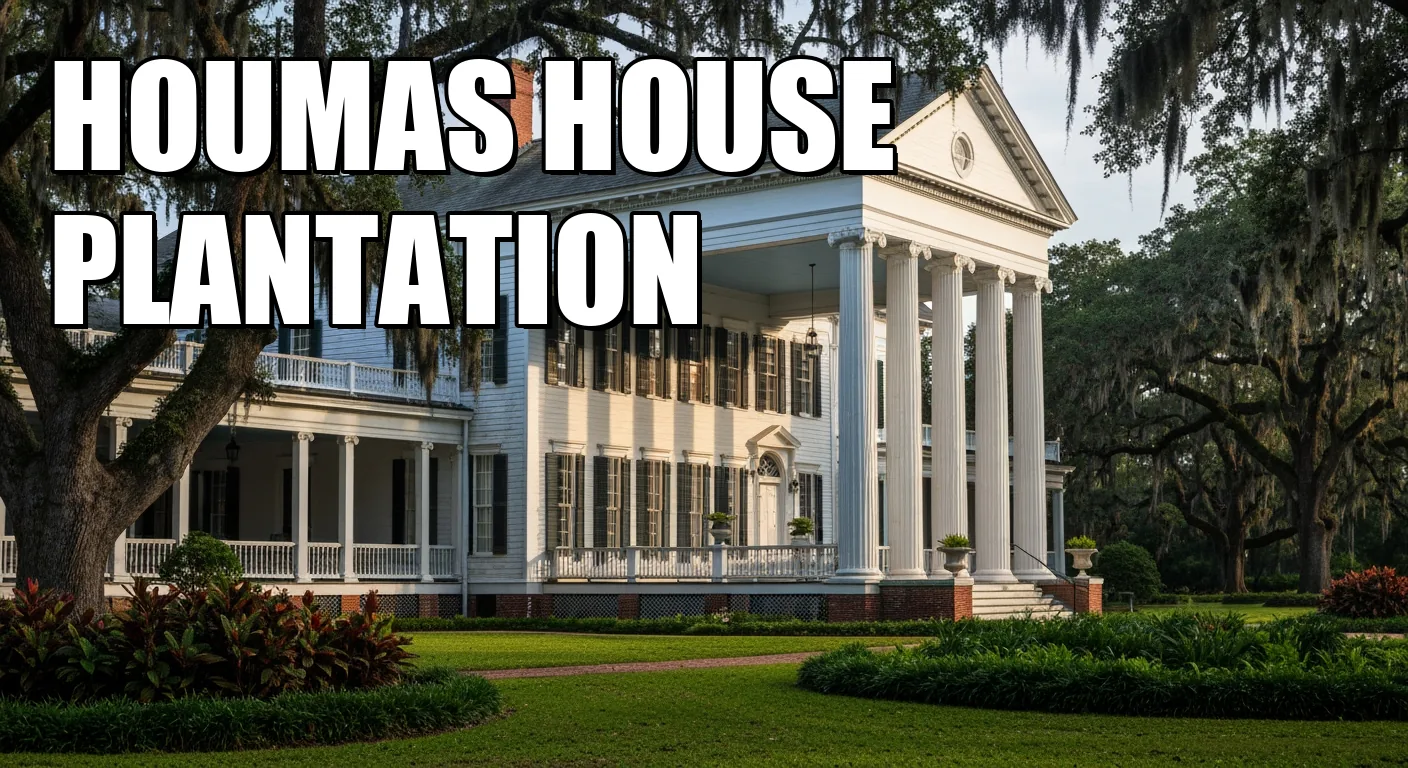
Houmas House is the mansion exterior in Hush…Hush, Sweet Charlotte. It is not the movie’s interior. The Historic New Orleans Collection states that the 1964 production filmed exterior shots in Darrow, while the interior scenes were made on a Los Angeles soundstage.
That distinction changes how a visitor should read the site. The house seen on screen was already a restored interpretation of the plantation era, and the landscaped property visitors see now has changed again. Beyond both images lay a sugar system far larger than the surviving mansion grounds.
The exterior is Houmas; the movie rooms are Hollywood
The Historic New Orleans Collection gives the cleanest production map: Houmas supplied exterior shots, and Los Angeles supplied the interiors. It also identifies the portrait of young Charlotte as a reused prop from Bette Davis’s 1938 film Jezebel. A real Louisiana façade, a California interior and an older studio prop were edited into one apparently continuous house.
This means the physical staircase inside Houmas needs two labels. The National Register nomination describes a graceful helix stair in the rear vestibule of the Greek Revival section. It is an existing architectural feature documented independently of the movie sets. But because the interior scenes were shot on a soundstage, it is not the screen staircase simply because a tour visitor can stand beside it.
The same rule applies to stories about a “Bette Davis room.” The sources reviewed establish Davis’s connection to the production and Houmas’s exterior role; they do not establish that she lodged in a particular mansion bedroom. That claim remains unverified. It should not be declared false, but neither should a named room be treated as film evidence without a contemporary lodging record.
The 1964 exterior was already a 1940s restoration
Even the real exterior does not represent one uncontested construction date. The smaller brick house attached at the rear dates broadly to the late eighteenth or early nineteenth century. Documentary research places a house on the site by 1809, but the familiar 1774 date belongs to the land purchase and should not automatically be transferred to the surviving structure.
The large peripteral Greek Revival mansion in front is usually dated to 1840 and associated with John Smith Preston and Caroline Hampton Preston. Records of Wade Hampton II buying building supplies in 1830 leave open an earlier date for the front section or its columns. The useful conclusion is a date dispute, not a forced compromise year.
Dr. George Crozat acquired a badly deteriorated property in 1940 and worked with architect Douglass Freret to present the main house toward an 1840s appearance. The National Register records substantial intervention. Crozat removed the old rear house’s staircase, changed fireplaces and mantels, added an upper hall, closets and cupboards, and installed modern services. He demolished two rooms that had connected the old and new houses and replaced them with the glazed breezeway visible today.
The landscape in the movie carried similar editorial choices. Mississippi River levee work destroyed most of the original oak approach, leaving a short allée. Crozat’s axial formal garden was a Colonial Revival composition modeled on the restored Governor’s Palace garden at Colonial Williamsburg. When the camera presented Houmas as a decaying Southern family seat, it was filming a genuine old mansion through a restoration undertaken roughly two decades earlier.
The present estate is not frozen in the film year
Kevin Kelly purchased Houmas House in 2003 and made another interpretive campaign visible. The belvedere was restored, the faux-marble exterior was painted ochre, interior finishes were reinstalled, a sugarcane mural was added, and the twin garçonnières were renovated. New gardens, water features, event buildings, restaurants and an inn expanded the property beyond the house-and-garden core documented in the National Register nomination.
A film fan can still compare the columned façade, galleries, roofline and grounds with the exterior shots. The comparison should allow for two directions of change: Crozat shaped the version filmed in 1964, and Kelly shaped the version encountered now. “Filmed here” is accurate. “Unchanged movie set” is not.
The camera frame contains only the elite core
John Burnside bought Houmas in 1857 with 12,000 acres and 550 enslaved people. By 1860, records counted 753 people enslaved by Burnside and living in 192 cabins. Historian Joseph Menn’s analysis, summarized by 64 Parishes, indicates that total likely covered four Burnside holdings in Ascension Parish rather than one concentration around the mansion.
The scale was industrial. Burnside expanded the acreage, operated four sugar mills and by 1862 produced 5,150 hogsheads—about five million pounds—of sugar. The National Register nomination described Houmas as the center of Louisiana’s largest slaveholding, with more than 800 enslaved people. That older summary captures the size of Burnside’s economic unit, but it should not be converted into a claim that 800 people lived on the present visitor grounds.
The nominated historic core covers about ten acres and includes the house, gardens, several surviving dependencies and building foundations. It is not the plantation system represented by the four holdings, mills, cabin landscape and thousands of cultivated acres. The movie’s mansion exterior is therefore real at one scale and radically incomplete at another: the owner’s house survives as the image, while most of the machinery and coerced labor that produced its wealth lie outside the frame.
When matching the film to the visit, label each claim or recognizable image as an on-location exterior, a studio interior, a restoration layer or the plantation system beyond the frame. Houmas House’s own film list names many later productions, but a credit list without an independent scene map cannot tell a visitor what to recognize. Sweet Charlotte is the stronger case because the source chain identifies exactly where the location work stops. The most useful comparison is not a hunt for every title. It is the seam where the Louisiana exterior cuts to a Hollywood room.
The Cornerstone Brief
One historic place, once a week — what it is, why it matters, whether it's worth going. No filler, no paid placements.
Coming soon. Unsubscribe any time.