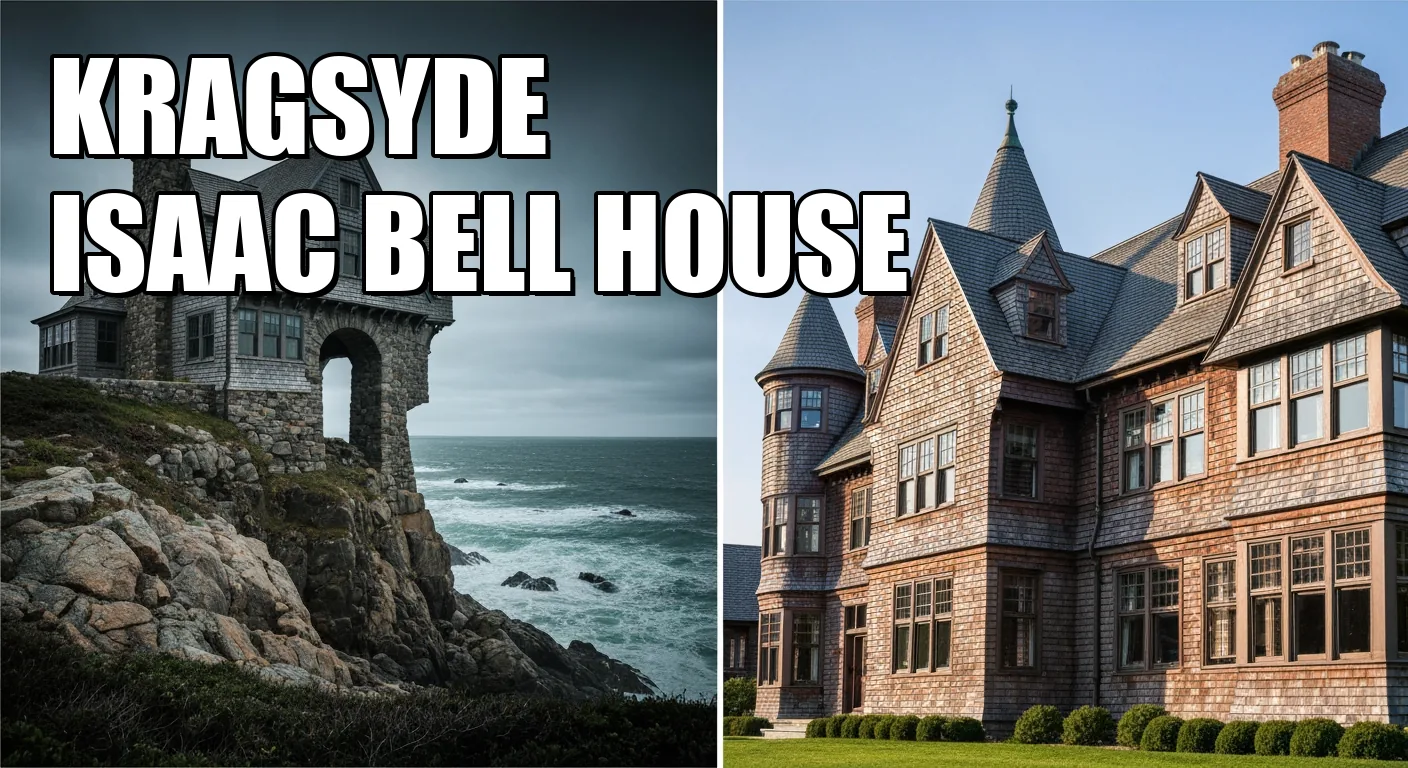
Kragsyde’s main house is gone, but its design is not undocumented. The Isaac Bell House still stands, but its current exterior is not an untouched skin from 1883: the restoration record says its façades and roof were entirely reshingled in the documented historic patterns. That is the useful paradox at the beginning of Shingle Style. “Lost” does not mean unknowable, and “preserved” does not mean materially unchanged.
The two houses should therefore not be ranked by a single authenticity score. Kragsyde is read through an 1882 estate plan, historic images, later scholarship and a modern mirror-image replica. Isaac Bell can be tested against a standing frame and interior, but also against later additions, replacement shingles, recreated ornaments and reproduced finishes. Before drawing a conclusion about either house, identify what kind of evidence is doing the work.
Kragsyde and Isaac Bell were overlapping experiments, not a relay race
The usual “dawn of Shingle Style” story invites a clean first-and-next sequence. The dates resist it. The Isaac Bell House National Historic Landmark nomination says McKim, Mead & White supplied plans in the summer of 1881, construction began soon afterward, and the Bell family occupied the house in summer 1883. The Library of Congress HABS record compresses that span to 1882–83. Both formulations describe an early-1880s project, but they are not identical.
Kragsyde overlaps it. The National Park Service records an 1882 plan for George Nixon Black Jr.’s Manchester-by-the-Sea estate and identifies Peabody & Stearns as the architects working with Frederick Law Olmsted. Old-House Journal gives an 1882–85 construction span, while a Colonial Society of Massachusetts account says Black commissioned Robert Swain Peabody in 1883. Those records support contemporaneous experimentation more strongly than a neat genealogy in which one finished house simply generated the other.
The name is later than both. A contemporary 1886 description called Isaac Bell a “modernized colonial style” house. Vincent Scully’s book The Shingle Style appeared through Yale University Press in 1955. The retrospective label is useful, but it should not be projected back as though Peabody & Stearns and McKim, Mead & White were following a finished style manual.
Five evidence labels prevent the comparison from collapsing
| Evidence label | What it can establish | Its limit |
|---|
| Design document | Planned geometry, circulation, siting and architect-client intent | Does not prove every detail was built or later survived |
| Historic depiction | Appearance at the date of a photograph, print or published sketch | Can hide materials, alterations and off-camera spaces |
| Surviving structure or fabric | Physical material that can be examined in place | May belong to more than one construction period |
| Restoration reproduction | A documented attempt to recover a lost pattern, finish or feature | Represents historical interpretation, not original material |
| Later replica or interpretation | How a design was translated for another site, owner or era | Cannot substitute for the provenance of the original building |
These labels are not a hierarchy. An original plan may be stronger evidence for an architect’s intended arrangement than a much-altered room. A surviving brick wall is stronger evidence for material than a drawing. A carefully documented reproduction can restore legibility without becoming nineteenth-century fabric. The mistake is asking one category to answer another category’s question.
Kragsyde survives as a documented design and landscape argument
The strongest official evidence for Kragsyde is not a surviving shingle wall. It is the documented collaboration between building and site. The National Park Service identifies George Nixon Black Jr. as the client, Peabody & Stearns as the architectural firm and Olmsted as the landscape designer. Its 1882 plan included a carriage house, stable, laundry yard and house yard. Olmsted oriented the house at the top of a rocky bluff overlooking Massachusetts Bay and used low shrubs and native trees to fit the estate into the coastal scenery.
The same NPS record singles out the massive archway built into the side of the house, allowing passage and a sightline across the property. That feature was not merely picturesque surface treatment. It joined circulation, view and massing: the building became a route through the site as well as an object on it. Kragsyde can therefore support a claim about integrated architectural and landscape design even when its original material cannot be inspected.
The loss still matters. The Colonial Society and Old-House Journal both date demolition to 1929. Old-House Journal reports that after Black’s death and the estate’s sale, the new owners razed the house to its foundation for a stucco residence. Plans and historic photographs preserve configuration and appearance; they cannot recover the feel of the original shingles, the construction sequence hidden behind them or the full experience of moving through an 1880s interior. Archival abundance is not material survival.
Kragsyde II is a translation, not a surviving fragment
Jane Goodrich and builder Jim Beyor began a replica on Swan’s Island, Maine, in 1982. Old-House Journal describes their use of photostatic copies of the original plans and the deliberate reversal of the floor plan into a mirror image to adapt it to a new site. It was built as their private residence and workspace, not as a transplanted portion of the Manchester house.
That distinction makes the replica more interesting, not less. Its mirror reversal records a new site decision. Its hand-built details record late-twentieth-century craft and commitment. It can help a reader imagine scale, sequence and spatial relationships that flat images obscure. It cannot provide original Kragsyde fabric, preserve Olmsted’s Manchester landscape or erase the interpretive decisions required to turn historic documents into a new house.
Isaac Bell preserves a building through original, altered and reproduced layers
Isaac Bell offers evidence Kragsyde cannot. The house remains on its Newport site with its structural frame, granite foundation, red-brick first story and documented interior elements. The National Historic Landmark and HABS records describe shingled upper walls in wave and diamond patterns, an unusually open first-floor plan organized around a large living hall, bamboo-style porch supports, and sliding drawing-room doors carried on Japanese-inspired bronze wheels. Thomas Galvin laid out the grounds; this is not an Olmsted landscape.
But the standing house is not a sealed 1883 artifact. A library was added around 1897–98, and a room and porch were added on the west elevation in the 1920s. The Preservation Society acquired the property in the mid-1990s—the Victorian Society account says 1994, while the HABS catalog says 1996—and used a 1995 Historic Structures Report to guide restoration.
The restoration record is unusually candid. The exterior façades and roof were entirely reshingled in the elaborate historic patterns. Fan-shaped decorations at the third-story east windows were recreated, missing elements replicated and original trim repainted. Inside, wall fabrics, wallpaper and glazing were duplicated; natural rattan wall covering was rewoven in China. Those interventions do not make the house fraudulent. They make it a documented preservation project in which surviving frame, masonry, woodwork and built-ins coexist with later residential change and modern reproduction.
That layered reading is more useful than calling the house either “original” or “reconstructed.” The surviving staircase, Breton bedstead incorporated into the living-hall inglenook and mahogany dining-room buffet can be evaluated as physical fabric. The replacement shingles reveal the restoration’s evidence and choices rather than the weathering of boards installed by the original builders.
Ask what the evidence proves before asking which house is more authentic
Use Kragsyde to study documented intent: the house-landscape collaboration, bluff orientation, estate plan and arch as a circulation device. Use Kragsyde II to study translation: what happens when an archived design is reversed and rebuilt for a different coast and household. Use Isaac Bell to study material and preservation together: the open plan and surviving structure, the additions made during residential use, and the reproductions that restored lost patterns.
The practical question for any Shingle Style claim is simple: is this conclusion based on a design document, a historic depiction, surviving fabric, restoration reproduction or a later interpretation? Once the label is visible, the two houses stop competing in a false lost-versus-saved contest. Kragsyde remains powerful through its estate plan, historic depictions and later archival record. Isaac Bell remains powerful because a standing building allows physical investigation—and because its restoration record identifies which visible elements are surviving fabric and which are modern preservation work.