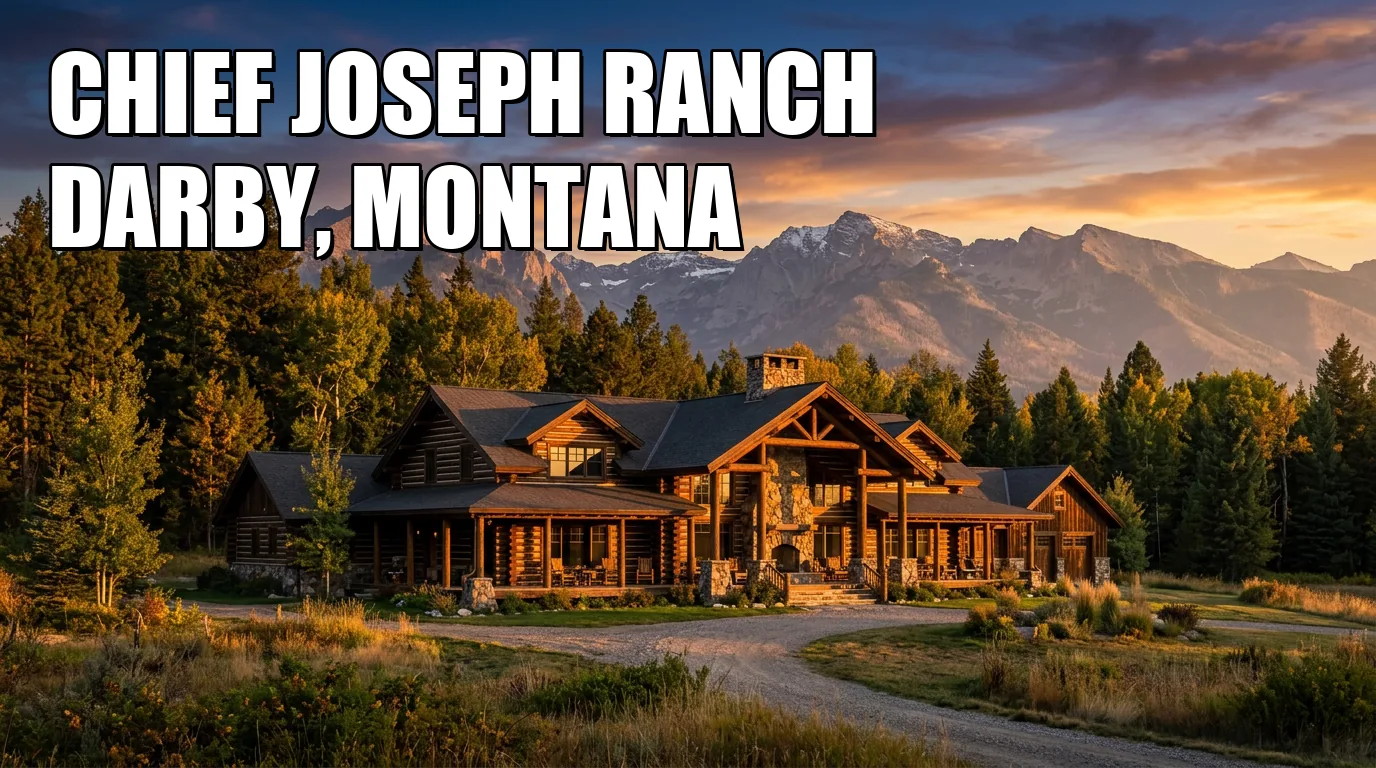
The mistake is making Chief Joseph Ranch the whole day. For most Yellowstone fans, the real Dutton Ranch is a conditional roadside view, not a walk-through attraction: there is no standalone public tour, filming can cancel even the normal gate-photo courtesy, and the main lodge is a private family home. The reliable trip begins when the ranch stops being the itinerary and becomes one possible stop inside the Bitterroot Valley.
The practical verdict: stop at the gate only when current ranch conditions allow it, never block the driveway, and do not expect entry. If you do not hold a cabin reservation, build the day around Darby, Lake Como, Painted Rocks or public Western Montana filming geography instead.
At the gate, the permission is narrow
Chief Joseph Ranch welcomes non-guests who photograph the Dutton Ranch sign at the gate, provided they do not block the drive. That courtesy disappears during filming, when security keeps the entrance clear for cast and crew. It is not permission to enter the property, wait for an opening, approach the barns or request an impromptu tour.
The on-property experience is attached to lodging. The ranch offers Lee Dutton’s Cabin, also called the Fisherman Cabin, and Rip’s Cabin, also called the Ben Cook Cabin, when reservations are available. The official cabin material includes a tour of the ranch and sets with either reservation. It does not sell that tour separately. The lodge itself is not another lodging choice: the ranch describes it as the family home.
This creates a clean decision before the drive. A cabin guest has a reservation-defined visit. Everyone else has a conditional gate photograph and the public valley beyond it. Checking current ranch notices before departure matters more than arriving early.
The real ranch is only part of the fictional ranch
Chief Joseph Ranch works on screen because it was not built as scenery. The property was homesteaded in 1880, and William S. Ford and Howard Clark Hollister purchased the 2,500-acre ranch in 1914. A three-year construction campaign produced the roughly 6,000-square-foot Ford-Hollister Lodge and three large barns. The dairy operation later shifted from Holsteins to Herefords; after Ford’s death in 1935, his family operated a guest ranch. The Chief Joseph Ranch name arrived after a sale in the early 1950s.
That history supplies Yellowstone with convincing ranch fabric: a log lodge, porches, yards, barns, corrals, cabins, fields, woods and a river property that belong to one real place. It does not mean every room or landscape in the fictional estate can be found behind the Darby gate.
The production has always assembled the Dutton world from multiple places. Park City reporting from the show’s early run described Utah Film Studios holding about 11 sets, including most Yellowstone Lodge interiors and the bunkhouse, while outdoor work also spread through Utah locations. Later Western Montana production used public-facing geography in Hamilton and Missoula as well as the Darby ranch. The useful distinction is between the ranch’s visual identity and the complete production map. A gate visit reaches the first, not the second.
Choose a public substitute by what you wanted from the ranch
| If you wanted… | Use this public alternative | What changes |
| Planning help before a mountain drive | Darby Historical Visitor Center | Get maps and current road, weather, permit and recreation information; the center is seasonal. |
| A managed mountain-and-water day | Lake Como Recreation Area | Choose swimming, hiking, fishing, boating or camping between Darby and Hamilton; vehicle access reaches only part of the shore. |
| A quieter West Fork landscape | Painted Rocks State Park | Use a reservoir park for fishing, paddling, picnicking or camping, but bring water and check current launch conditions. |
| More actual Yellowstone geography | Downtown Hamilton and Missoula | See public streets and exteriors used by production without treating a private ranch as a studio tour. |
Darby is the control point, not merely the closest bed
The Darby Historical Visitor Center is useful because Bitterroot access changes with season, fire, road and water conditions. The center occupies a 1937–1939 Civilian Conservation Corps building on North Main Street and provides Forest Service maps, topographic maps, permits and local recreation information. Its published season runs from May through September, with an October-through-April closure, so confirm current hours rather than making it the only fixed stop.
That information-first pause solves a problem the ranch cannot: it tells you which public landscape is workable that day. In a hot, smoky or low-water period, the best choice may change between a lake, a state park, a short town stop and no backcountry drive at all.
Lake Como and Painted Rocks are not interchangeable
Lake Como Recreation Area, between Darby and Hamilton, is the more developed choice. The Forest Service lists swimming, fishing, boating, hiking, mountain biking, horseback riding and camping. Its sandy summer beach has picnic and changing facilities, while several campgrounds serve different users. Vehicles need a daily, seasonal or qualifying federal recreation pass from Memorial Day through Labor Day. The important limitation is physical: Lake Como has about eight miles of shoreline, but only about half a mile is accessible by vehicle.
The reservoir is also working infrastructure. Its levels fluctuate for irrigation and are normally highest from spring through late July. A photograph of a full blue lake is therefore not a promise of late-season conditions. Check current alerts, fire restrictions and water levels before choosing boating or swimming as the day’s anchor.
Painted Rocks State Park is the more remote West Fork option. The reservoir supports boating, fishing, paddling, hiking, wildlife viewing, picnicking and camping in a pine-forest setting. The park normally operates from dawn to dusk throughout the year, but amenities and launch conditions can be seasonal or restricted. The current park page warns that low water can reduce its ramp to hand launching and identifies the Forest Service launch at Little Boulder as the trailer alternative, so boaters need the live alert rather than an evergreen promise. Of 25 campsites, six are reservable Thursday through Sunday from Memorial Day through Labor Day; the rest are first come. There is no potable water, so bring drinking water even for a day visit.
For screen geography, continue north rather than pressing the gate
Visitors who want more television evidence can use public Western Montana locations instead of searching for a way onto the ranch. A building at 163 South Second Street in Hamilton supplied the Montana Livestock Association exterior for season-four scenes. Downtown streets remain public, but the filming credit does not create interior access to the building; view it as civic architecture from lawful public space.
Missoula widened the production map further. The show used Community Medical Center, Ruby’s Cafe, the Railroad and Woody streets area, and the Missoula County Courthouse for later storylines. These places prove why “the Dutton Ranch” cannot be decoded at one address. The series edits a private Darby property, ordinary businesses, government buildings, roads, landscapes and constructed interiors into a continuous Montana.
A day that survives a closed gate
If filming history matters more than outdoor recreation, continue through Hamilton toward Missoula and read the show as a production composite. That route gives you more real Yellowstone geography than lingering beside a private driveway ever could.
Chief Joseph Ranch remains the visual anchor of the Dutton story, but public access is not what makes the place convincing on screen. The useful trip respects the ranch’s boundary, recognizes the stage-and-location illusion, and lets the Bitterroot Valley carry the day when the gate cannot.