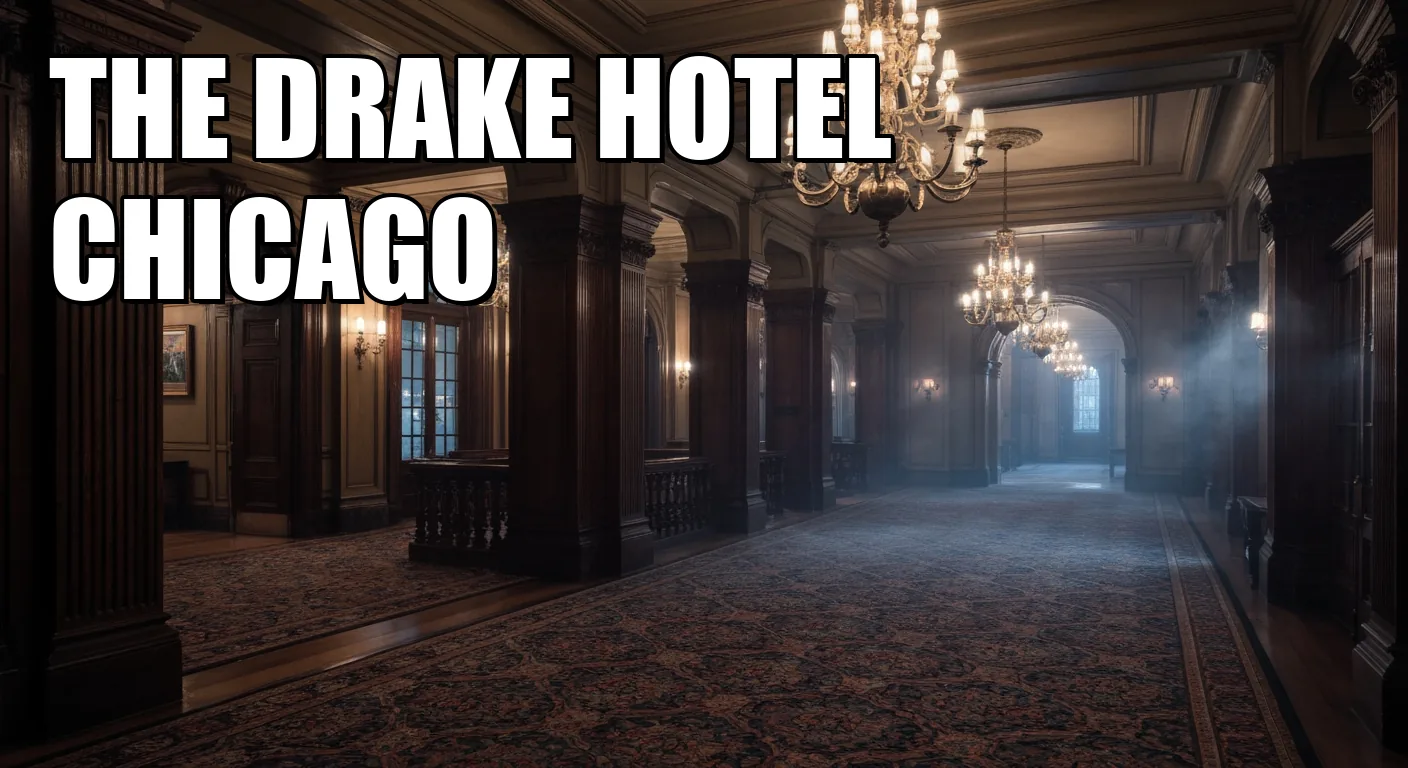
Two Drake ghost stories do not rest on the same kind of evidence. The Lady in Red depends on an untraced story about a suicide during the hotel’s New Year’s Eve opening celebration. The “Woman in Black” is a later paranormal name attached to a real shooting in Room 836 on January 19, 1944. The crime is documented. The apparition is not.
Exact details make both stories sound archival: a tenth floor, a red dress, Room 836, a black coat. But those details come from three different layers—contemporary records, later accounts citing primary records that have not been produced, and modern folklore. Keeping those layers separate changes the Drake from a generic haunted hotel into a useful lesson in how a building lends credibility to a legend.
The Drake opened to the public before its famous New Year’s Eve gala
John B. Drake and Tracy Corey Drake financed and managed the hotel, designed by the firm Marshall & Fox. The brothers laid its cornerstone on January 17, 1920. The date commonly attached to the grand opening is December 31, when the Drake’s own history says its doors opened to 2,000 of Chicago’s most distinguished citizens.
A contemporary newspaper account complicates that version. A Chicago Tribune item dated November 26, 1920, reprinted by Chicagology, says the hotel “was opened to the public yesterday.” That places public operation on November 25. The safest reconciliation is that November marks the start of business and New Year’s Eve the formal celebration. December 31 should not be presented as the literal first day anyone could enter the hotel.
The Lady in Red legend fastens itself to the more theatrical date. In modern versions, a woman discovers her fiancé with someone else during the celebration and jumps from the tenth floor or roof. None of the primary 1920–21 material reviewed for this article records that death. One paranormal page says historians searched the newspapers, but it does not document the search, its database or its limits. The evidence therefore supports a narrower conclusion: the suicide is unverified, and the story’s first publication remains unknown. It does not support declaring who invented it or when.
The FBI documented a murder, not a Woman in Black
The May–June 1944 FBI Law Enforcement Bulletin is much firmer. Chicago’s chief of detectives asked the bureau to publish photographs of the revolver used by the murderer of Mrs. Frank Starr Williams, identified in later accounts as Adele Born Williams. The bulletin places the crime in Room 836 on the eighth floor of the Drake on January 19, 1944.
At about 6:05 p.m., Williams returned to the room with her daughter, Patricia Goodbody. While Goodbody was in the bathroom, she sensed another person in the suite. She saw a woman who fired at her, heard further shots and then watched the assailant leave. Goodbody found her mother on the bedroom floor, bleeding from the head, and ran into the corridor for help. The weapon—an Iver-Johnson .38-caliber, five-shot revolver—was later found on a servants’ stairway between the third and fourth floors.
That is already a substantial primary record. It is also where the bulletin stops. It calls the attacker a “woman assailant”; it does not describe a black Persian lamb coat, a wig or flowers. It does not mention a missing room key, identify the suspects later named in retellings or establish the investigation’s ultimate outcome. Published months after the shooting while police were still tracing the gun, it proves an active investigation in 1944, not by itself that the case remained officially unsolved forever.
Later writers attribute the black-coat description, witness dialogue, key evidence and suspect history to contemporary Tribune coverage. Those may be traceable claims, but without the newspaper pages in hand they belong in a second evidence tier, not beside the FBI bulletin as if both had been inspected directly.
A black coat is not the provenance of a ghost
Even if the newspaper description of a black coat is quoted accurately, it describes a living suspect leaving a crime scene. It does not name a phantom. The capitalized “Woman in Black” appears in modern paranormal accounts that attach apparition reports to the eighth floor and connect them to the murder.
This makes the two Drake legends unequal without making either one proof of a haunting. The Lady in Red story currently lacks a verified underlying death and a traceable origin. The Woman in Black story borrows its setting from a documented homicide, then adds a named supernatural figure. A real victim does not authenticate every later claim made in the same corridor.
The building supplies geography, not proof
The Drake’s physical history is unusually good at making stories feel settled. The hotel stands within the East Lake Shore Drive Chicago Landmark District. The space now called Palm Court was originally Fountain Court. A storyteller can point to a floor, a room number or a named public space, and the claim immediately gains a map.
But a real location establishes only where a story has been placed. It does not establish that the story happened there. The November newspaper item and the hotel’s New Year’s Eve history show the same problem in a non-paranormal form: one building can carry two “opening” dates because the dates describe different events. Place names and precise numbers have to be tied back to the source that gives them meaning.
Use three labels when reading the Drake’s legends
Documented directly: the hotel was open to the public by November 25, 1920; its own history commemorates a New Year’s Eve celebration; Marshall & Fox designed it for the Drake brothers; and the FBI bulletin records the 1944 attack in Room 836 and recovery of the revolver.
Later report with an absent primary citation: the black Persian lamb coat, additional witness dialogue, missing key, named suspects and the claim that the case ultimately remained unsolved. These details should be attributed to later accounts unless the original police or newspaper records are produced.
Modern legend with unknown origin: the opening-night suicide of the Lady in Red, sightings attributed to her, and the proper-name ghost called the Woman in Black. Their circulation is evidence that the folklore exists, not that the supernatural events occurred.
The best reader task is simple and can be done without entering a guest corridor. For every Drake story, write down three things: the recorded event, the source actually available, and the hotel space later attached to it. The substitution becomes visible quickly. A gala becomes the hotel’s first day; a suspect’s alleged clothing becomes a ghost’s name; Room 836 becomes evidence for an apparition.
The Drake does not need false certainty to be interesting. Its record already contains a hotel open for business before the date it celebrates, a precisely documented 1944 murder and two legends that use that precision selectively. A room number is geography. It is not a citation.